
Witch Hazel for Yeast Infection: What Evidence Shows

Witch hazel is not an evidence-based treatment for a vaginal yeast infection, and standard antifungal therapy remains the recommended care. The plant has a medicinal history documented back to 1751, but tradition isn't proof that it cures Candida in the vagina.
A lot of advice online treats witch hazel as if “natural” and “soothing” automatically mean “safe and effective.” That's sloppy thinking. If you're dealing with itching, burning, and discharge, the question isn't whether witch hazel can make skin feel tighter for a few minutes. The question is whether it can clear a yeast infection. Based on the evidence, it can't be recommended for that job.
Table of Contents
The Honest Verdict on Witch Hazel for Yeast Infection - What deserves a yes, and what does not - Why I would not recommend it - What to do instead
What a Vaginal Yeast Infection Actually Is - Common symptoms - What tends to trigger it - How clinicians sort it out - What standard care looks like
A Short History of Witch Hazel in Medicine - Why it became so popular - Where tradition overreaches
What the Modern Research Actually Shows - One lab finding keeps getting stretched too far - Human proof is missing - Symptom studies do not rescue the case - Why the lab result does not translate cleanly - Witch Hazel vs. Standard Antifungals
Why Witch Hazel Can Make Things Worse - Why the “tightening” feeling misleads people - Inflamed vulvar skin doesn't need harsh experiments - Safer comfort measures
Evidence-Based Treatments Worth Using Instead - The practical options - Antifungal options at a glance - How I'd choose
When Self-Care Stops Being Enough - Red flags that should push you to a clinician - Why home treatment sometimes misses the mark - What to do next
A Practical Take-Home Plan - The five steps I'd follow - The plain takeaway
The Honest Verdict on Witch Hazel for Yeast Infection
Witch hazel gets far too much credit in this conversation.
Here is the plain answer: it is not a proven treatment for a vaginal yeast infection. The strongest argument in its favor is a narrow lab signal from one witch hazel-containing formulation, not human evidence that it clears vulvovaginal candidiasis in real patients.
That distinction matters. A product can slow Candida in a lab and still fail inside the vagina, where moisture, pH, friction, normal bacteria, and inflamed tissue all change the outcome.
What deserves a yes, and what does not
Witch hazel may have some astringent and soothing effects on skin. That is the part people notice and then overinterpret. Feeling drier, tighter, or briefly calmer is not the same as treating the infection itself.
The article gets stronger if you separate two claims instead of blending them together:
Possible lab activity: one formulation containing witch hazel showed antifungal activity against Candida
Actual clinical treatment: there is no good human proof that witch hazel cures vaginal yeast infections
Those are not interchangeable claims.
My verdict: interesting ingredient, poor treatment choice.
Why I would not recommend it
The vaginal area is easy to irritate and hard to self-treat correctly. Witch hazel products vary a lot. Some contain alcohol, fragrance, preservatives, or an acidic base that can sting already inflamed tissue. If the skin is raw, burning, or swollen, that can make symptoms feel worse, not better.
Acidified witch hazel is the biggest concern here. Articles that call witch hazel “soothing” often skip that detail. In an active yeast infection, extra acidity on irritated vulvar tissue can backfire.
What to do instead
Use a treatment that is meant to clear yeast. Standard options still include antifungals such as miconazole, clotrimazole, tioconazole, or fluconazole, and major medical references continue to direct patients toward those therapies rather than home remedies (MedlinePlus guidance on vaginal yeast infection treatment).
If your goal is to cure the infection, skip witch hazel. If your goal is temporary comfort, be careful, because the wrong product can add more irritation to tissue that is already angry.
What a Vaginal Yeast Infection Actually Is
A vaginal yeast infection, also called vulvovaginal candidiasis, happens when Candida overgrows and the vaginal environment loses its normal balance. The species most often involved is Candida albicans, which is why that name comes up so often in treatment discussions.
This isn't just “itchy skin.” It's a fungal overgrowth in a specific body site with its own chemistry, protective bacteria, and irritation patterns. That's why random topical remedies often disappoint.
Common symptoms
Symptoms usually include a mix of internal and external irritation. People often notice:
Itching and burning that can become hard to ignore
Thick white discharge, often without a strong odor
Redness and soreness of the vulva
Pain with urination, especially when urine touches irritated outer skin
Discomfort during sex, especially if the tissue is already inflamed
Not every itchy vagina is yeast. That's one of the biggest reasons self-treatment goes wrong.
What tends to trigger it
Several patterns can set the stage for Candida overgrowth:
Antibiotic use can disrupt the normal bacterial balance
Hormonal shifts can change the local environment
Poorly controlled diabetes can make yeast overgrowth more likely
Immune suppression can make infections harder to control
Tight, non-breathable clothing can trap moisture and friction
A first-time episode is where people most often misdiagnose themselves. Yeast can look like dermatitis, bacterial vaginosis, or another vaginal condition.
How clinicians sort it out
Diagnosis usually starts with symptoms and an exam. Depending on the setting, a clinician may use:
Symptom review to understand itch, discharge, burning, and timing
Microscopy or wet mount to look for yeast
Vaginal pH testing to help separate yeast from other causes
Culture or additional testing if symptoms are recurrent or treatment fails
A correct diagnosis matters more than most people think. The wrong treatment can leave the real problem untreated and make the tissue angrier.
What standard care looks like
For uncomplicated cases, first-line treatment is usually a topical azole antifungal or oral fluconazole, depending on the person and the clinical situation. That baseline matters because any alternative remedy should be judged against one simple question: can it do what proven antifungals do?
Witch hazel hasn't earned that comparison.
A Short History of Witch Hazel in Medicine
Witch hazel didn't come out of nowhere. It has a long medicinal history, which helps explain why it still shows up in intimate-care conversations today.
Documented medicinal use stretches back to at least 1751 among Native American communities, and European colonists were already documenting home-remedy use by around 1816. Traditional uses included inflammation, sore eyes, bruises, scratches, and hemorrhaging, and European phytotherapy later adopted it more formally in the nineteenth century (University of Vermont overview of traditional witch hazel medicine).
Why it became so popular
Witch hazel built its reputation as an astringent. In plain terms, it became known for drying, tightening, and calming irritated tissue.
That reputation fits a lot of everyday complaints:
Minor skin irritation
Post-shave sting
Hemorrhoid care
Superficial swelling
General “tightening” or drying
You can see how that history drifted into genital-care marketing. If something has been used for inflamed skin for generations, people naturally start applying it to vulvar irritation too.
Where tradition overreaches
The problem is that traditional use doesn't tell you whether it kills yeast in the vagina. Historically, witch hazel belonged in the soothing-and-astringent category, not the targeted antifungal category.
That's why modern claims about discharge, irritation, leucorrhoea, or thrush need context. Those uses are rooted far more in herbal tradition than in strong clinical evidence.
Old use can explain why a remedy is popular. It can't prove that the remedy works for the exact condition you have now.
What the Modern Research Actually Shows
The research on witch hazel gets overstated fast. One formulation showed antifungal activity in a lab. That is a narrow finding, and it does not mean the bottle of witch hazel at the pharmacy treats a vaginal yeast infection.
One lab finding keeps getting stretched too far
As noted earlier, the modern review literature describes a specific formulation containing witch hazel distillate plus urea that inhibited Candida albicans in laboratory testing. That is the signal worth taking seriously.
The problem is what happened next. Articles blurred "a tested formulation slowed Candida in vitro" into "witch hazel treats yeast infections." Those are not the same claim. Distillate is not the same as bark extract. A blended formulation is not the same as plain over the counter witch hazel. Product type matters.
Human proof is missing
What you want to see for a vaginal yeast infection is simple. A human trial where people with confirmed vulvovaginal candidiasis use the treatment and get better.
That proof is missing for witch hazel.
Here is the practical reading of the evidence:
No solid human trial shows witch hazel cures vulvovaginal candidiasis
No good evidence shows standard over-the-counter witch hazel clears the infection
No evidence supports swapping antifungal medicine for witch hazel
That gap matters. A petri dish can show inhibition and still tell you very little about what happens on inflamed vaginal or vulvar tissue.
Symptom studies do not rescue the case
Witch hazel has also been studied in intimate-area comfort settings such as postpartum or perineal care. That is not the same problem as a yeast infection, and even there the benefit was not impressive. In reviewed materials, witch hazel pads did not clearly outperform basic cooling measures for symptom relief.
So the evidence is weak in two separate ways. There is no convincing clinical proof it treats the infection itself, and there is not much reason to trust it as a standout comfort measure either.
Why the lab result does not translate cleanly
A vaginal yeast infection happens in living tissue with moisture, mucus, friction, resident bacteria, and an already irritated surface. A substance can look active in a formulation study and still fail where it counts. It may not reach the right area. It may not stay in contact long enough. It may dry or sting tissue before it helps.
That is the mistake many herbal summaries make. They lump witch hazel into the "soothing remedies" bucket and stop there. The more honest read is narrower. One formulation has a laboratory signal against Candida. Clinical evidence that witch hazel cures vaginal yeast infections does not exist.
Witch Hazel vs. Standard Antifungals
Therapy | Lab Activity vs. Candida | Human Clinical Trial | FDA-Recognized Indication |
|---|---|---|---|
Witch hazel | Limited indirect signal tied to a specific formulation involving witch hazel distillate with urea | No solid proof located for curing vulvovaginal candidiasis | No established evidence-based indication for treating vaginal yeast infection |
Miconazole | Used as an antifungal standard in routine care | Yes, used in standard care | Yes, recognized antifungal use |
Clotrimazole | Used as an antifungal standard in routine care | Yes, used in standard care | Yes, recognized antifungal use |
Tioconazole | Used as an antifungal standard in routine care | Yes, used in standard care | Yes, recognized antifungal use |
Fluconazole | Used as an antifungal standard in routine care | Yes, used in standard care | Yes, recognized antifungal use |
My advice is plain. Do not mistake a lab clue for a treatment plan. If you need to treat a yeast infection, use an antifungal with human evidence behind it.
Why Witch Hazel Can Make Things Worse
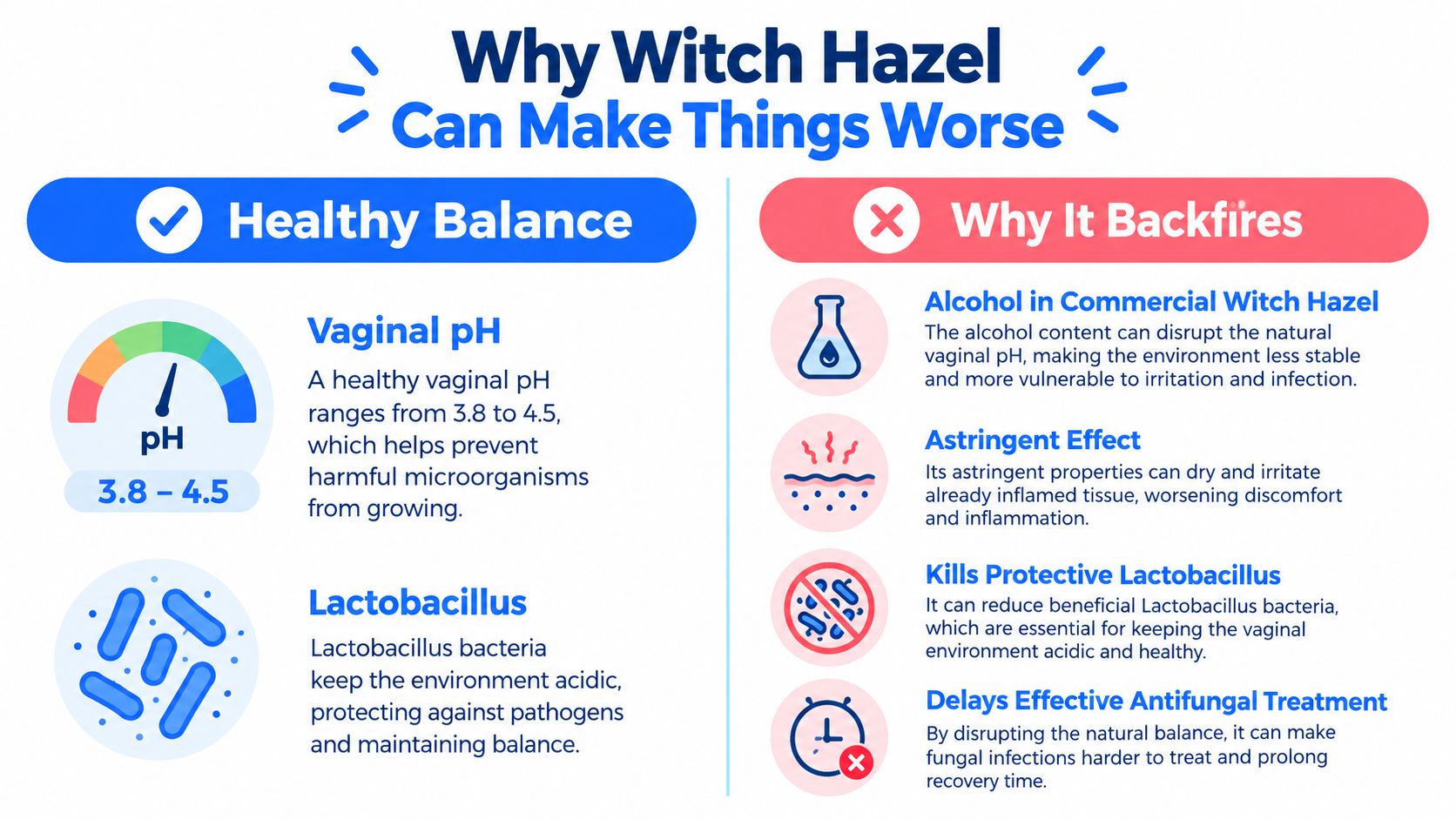
The biggest problem with witch hazel isn't just that it may not help. It's that it can make already irritated tissue feel worse.
A medical expert source on this question states that witch hazel “absolutely does not” fight or prevent a yeast infection and may worsen symptoms by acidifying the vaginal environment, while standard care remains antifungal therapy such as short-course vaginal azoles or oral fluconazole for uncomplicated cases (expert explanation on why witch hazel isn't a yeast infection treatment).
Why the “tightening” feeling misleads people
Witch hazel is an astringent. That tightening sensation can fool people into thinking it's fixing something. It usually isn't.
What may be happening:
Tissue contracts temporarily, which can feel like “relief”
Stinging gets mistaken for potency
Drying masks moisture-related discomfort
The infection keeps going underneath
That's a bad trade if the tissue is already raw.
Inflamed vulvar skin doesn't need harsh experiments
Many commercial intimate-area products create another problem. They're not just witch hazel in a vacuum. They may include ingredients or product styles that sting damaged skin, especially around the vulva where fissures, scratching, and redness are common.
If your main issue is outer itching, a brief course of a clinician-approved external anti-itch option may make more sense than astringents. In some cases, people ask about products like hydrocortisone cream, but steroid use near yeast symptoms can be tricky because it may calm irritation without treating the fungal cause. That's why I wouldn't self-prescribe it for vaginal symptoms unless a clinician has already told you exactly how to use it.
Soothing and curing are different actions. Don't confuse a temporary skin sensation with infection control.
Safer comfort measures
If you're miserable while antifungal treatment works, stick to low-risk comfort measures:
Cool sitz baths for external relief
Loose cotton underwear to reduce moisture and friction
Plain water cleansing instead of wipes, washes, and sprays
Water-based lubricant if intercourse is uncomfortable and you've been told sex is otherwise okay
Those steps won't cure the infection either, but they're less likely to make inflamed tissue angrier.
Evidence-Based Treatments Worth Using Instead
Skip the witch hazel experiment and treat the fungus.
For a straightforward yeast infection, the products worth using are antifungals made for vulvovaginal candidiasis. That means azoles. They target Candida directly, which is the part witch hazel has never proven it can do in actual patients.
The practical options
These are the standard choices:
Miconazole A reliable over-the-counter vaginal azole for uncomplicated cases.
Clotrimazole Another standard azole. If you want a cream, Canesten Vaginal Cream with clotrimazole is a typical example.
Tioconazole A topical azole often picked for a shorter, more convenient regimen.
Fluconazole An oral antifungal that can work well in the right patient, but it is not the best default for everyone.
Antifungal options at a glance
Treatment | Form | Typical Course | What it's good for | Key Cautions |
|---|---|---|---|---|
Miconazole | Vaginal cream or suppository | Single-dose or multi-day, depending on product | Uncomplicated yeast infection self-care | Can sting inflamed tissue. Make sure the symptoms really fit yeast |
Clotrimazole | Vaginal cream or tablet | Single-dose or multi-day, depending on product | Uncomplicated yeast infection self-care | External itching may still need gentle comfort measures |
Tioconazole | Vaginal ointment | Often a shorter course | Convenience if you want a one-step topical option | A poor pick if the diagnosis is murky |
Fluconazole | Oral tablet | Often a single oral dose when appropriate | Selected cases confirmed or strongly suspected to be yeast | Avoid casual self-use in pregnancy, recurrent symptoms, or diagnostic uncertainty |
How I'd choose
For first-time symptoms, pregnancy, or a very irritated vulva, start with a topical azole. It treats the likely cause without adding the extra variables that come with improvised remedies.
If you have had a clinician-confirmed yeast infection before and this episode feels the same, an over-the-counter azole is the sensible move. If symptoms keep returning, fail to improve, or never fit the usual pattern, stop guessing and get examined.
When Self-Care Stops Being Enough
A simple uncomplicated yeast infection can be reasonable to self-treat. A confusing, recurrent, or severe one shouldn't be.
Red flags that should push you to a clinician
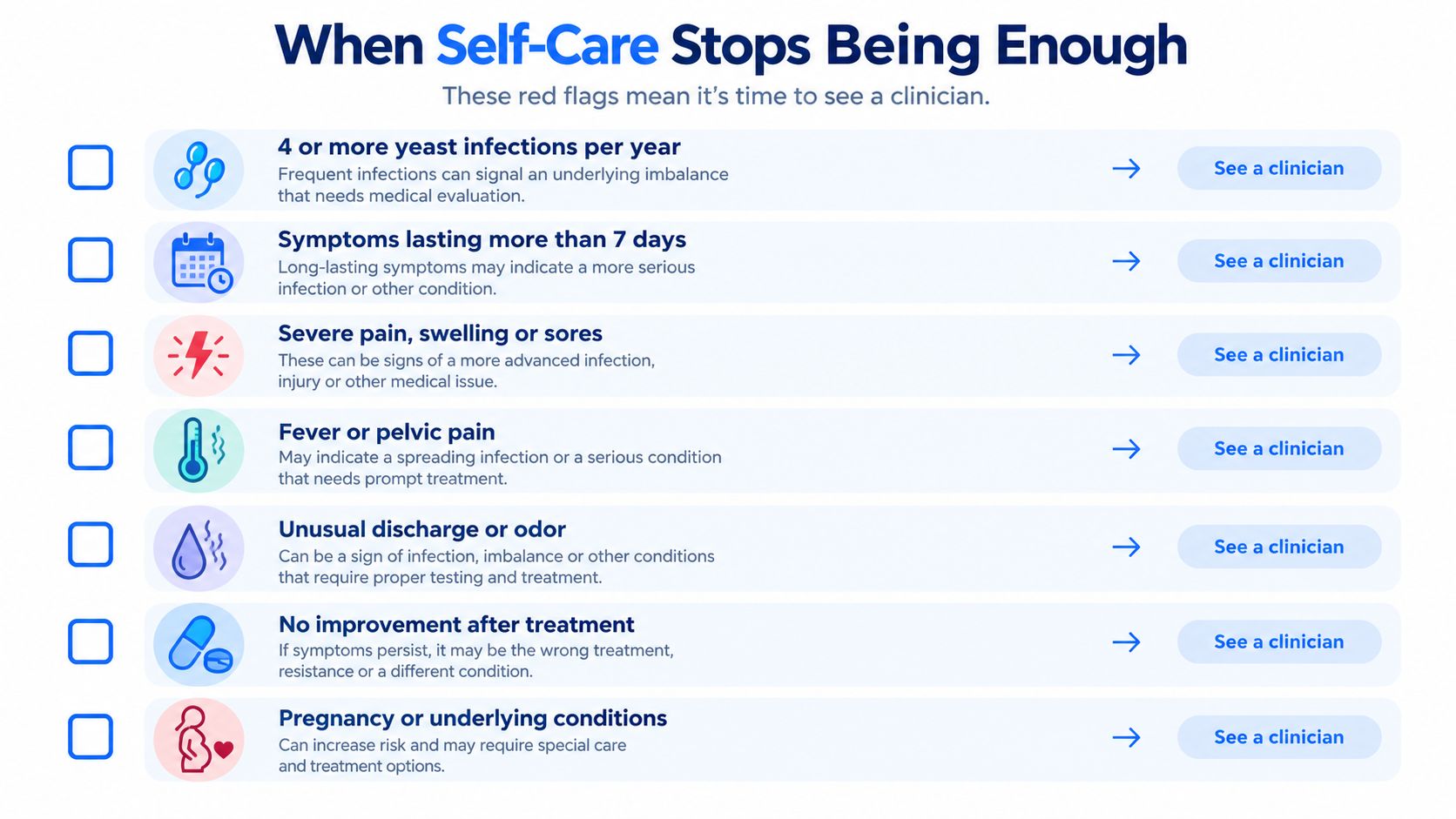
Book a visit if any of these apply:
Symptoms don't improve after treatment starts That raises the chance that the diagnosis is wrong, the yeast is harder to treat, or something else is going on.
Symptoms come back quickly Recurrence suggests you may need testing, not repeated guesswork.
The tissue looks badly inflamed Marked swelling, cracks, sores, or severe redness deserve a real exam.
You have fever, pelvic pain, or unusual odor Those features point away from a simple yeast infection.
You're pregnant or immunocompromised In those settings, self-treatment should be more cautious.
You've already tried one product and it failed Repeating the same strategy usually just delays the right diagnosis.
Why home treatment sometimes misses the mark
Yeast-like symptoms can overlap with bacterial vaginosis, trichomoniasis, contact dermatitis, or irritation from products. Recurrent cases can also involve less straightforward fungal patterns that need culture, microscopy, or a clinician's judgment.
If you're considering oral treatment after failed over-the-counter therapy, a clinician may decide that a medicine such as Forcan 50 mg or another antifungal approach is appropriate, but that decision should follow diagnosis, not frustration.
If you've already treated yourself and nothing changed, the next smart move is evaluation, not a stronger home remedy.
What to do next
Ask for an exam and testing if needed. If the story is messy, request microscopy or culture rather than assuming every itch is Candida.
That's how you stop the cycle of mistreating the wrong problem.
A Practical Take-Home Plan
You don't need a wellness ritual for this. You need a clean plan.
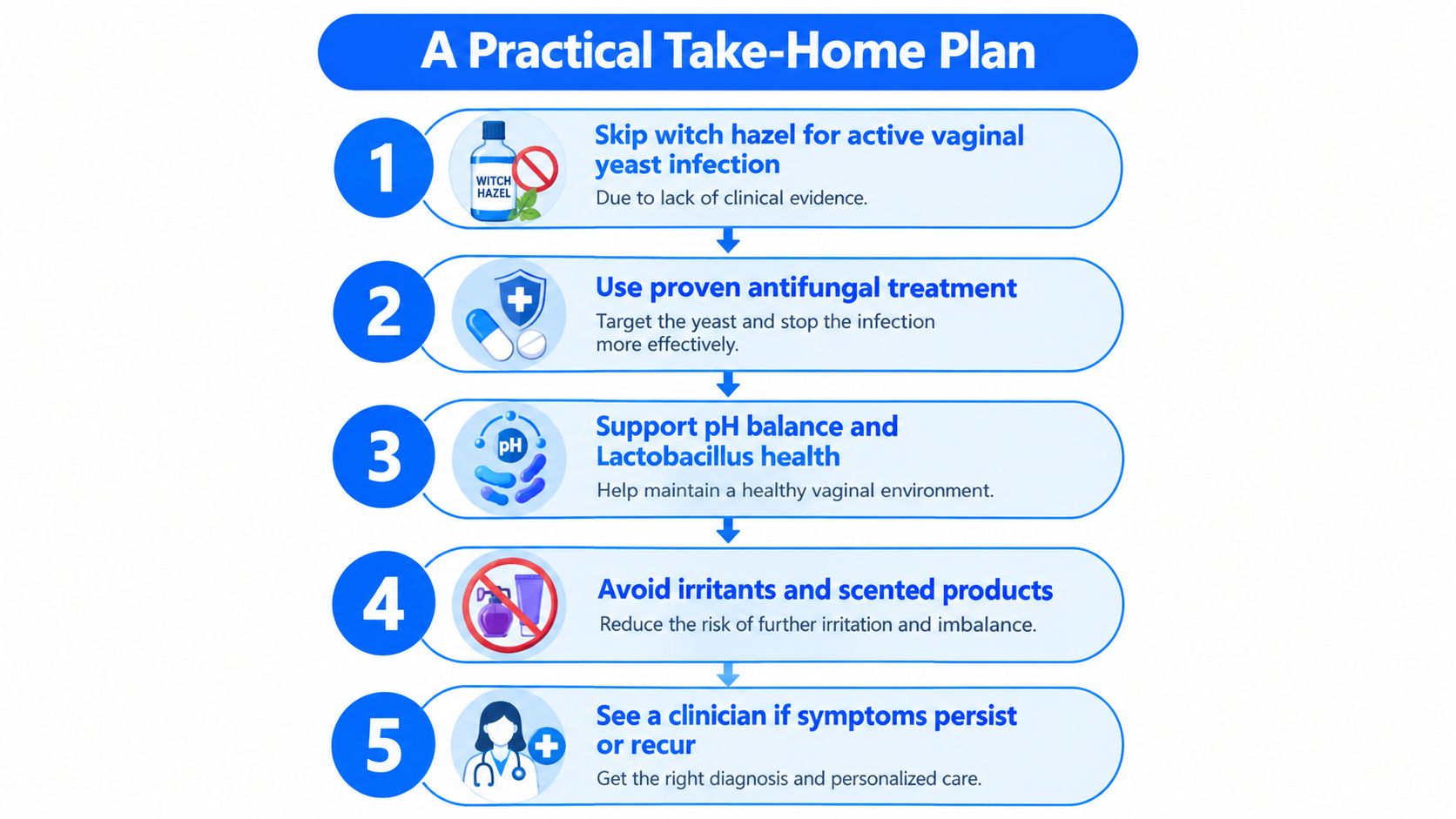
The five steps I'd follow
Skip witch hazel for an active vaginal yeast infection It isn't an evidence-based cure, and it may aggravate irritated tissue.
Make sure the pattern fits yeast Itching with thick white discharge is one thing. Bad odor, pelvic pain, sores, or major swelling are another.
Use a proven antifungal Reach for miconazole, clotrimazole, tioconazole, or clinician-directed fluconazole instead of trying to make an astringent do an antifungal's job.
Keep the area boring Use plain water externally, wear breathable underwear, and stop using scented washes, wipes, or sprays.
Reassess if it isn't improving If symptoms worsen, fail to improve, or return soon after treatment, get checked.
The plain takeaway
Witch hazel for yeast infection is one of those ideas that sounds sensible until you separate tradition, lab findings, and real treatment evidence. Once you do that, the answer is straightforward: don't use witch hazel as your treatment plan when proven antifungals already exist.
If you need affordable antifungal medicines, everyday health products, or support finding practical treatment options online, TheMedicineKart offers a broad pharmacy catalog with generic and OTC choices. For readers dealing with yeast infection symptoms, it's a straightforward place to look for commonly used products while you stick to evidence-based care instead of unreliable home remedies.

Comments