
Generic Viagra Side Effects What to Expect and Watch For

You've got the tablet in hand, or maybe it's still in the online cart, and the question isn't really “does sildenafil work?” It's “what's going to happen after I take it?” Those asking about generic Viagra side effects want a plain answer: what's normal, what feels unpleasant but temporary, and what means stop and get help.
That's a reasonable question. Generic sildenafil contains the same active ingredient as brand-name Viagra, so the side-effect profile is the same. The name on the box may differ, but the body reads the active ingredient, not the branding.
Table of Contents
Introduction to Generic Viagra and Why Side Effects Happen - Why the generic version has the same side effects - The question most people are really asking
How Sildenafil Works in Your Body - A simple pipe-and-valve analogy - Why side effects show up outside sexual function - Why dose and timing still matter
Common Side Effects and How Often They Occur - Common Sildenafil Side Effects vs Placebo in FDA Trials - What these common effects usually feel like - How to judge what you are feeling - What you can usually do at home
Rare but Serious Risks You Should Not Ignore - Which serious problems have been reported - Vision and hearing symptoms deserve special attention - When the symptom is a red flag
Drug Interactions and Health Conditions That Raise Risk - The highest-risk combination - Other medicines and conditions that need caution - Symptoms that may suggest low blood pressure or an interaction
How to Use Generic Sildenafil More Safely and When to Seek Help - A simple safety routine - How to decide: wait, call, or get emergency help - A quick note on vision changes
Introduction to Generic Viagra and Why Side Effects Happen
A common first-use scenario goes like this. Someone takes sildenafil for the first time, notices a warm face, a stuffy nose, maybe a headache, and immediately wonders whether they made a mistake. That reaction is understandable, especially with a medicine tied to blood flow, blood pressure, and sexual performance.
Most side effects linked with sildenafil are expected effects of how the drug works. They're often temporary and mild. They can still be annoying, but they usually aren't a sign that something dangerous is happening.
Why the generic version has the same side effects
Generic Viagra uses sildenafil as its active ingredient. That means the expected benefits and expected risks come from the same drug action. If you're searching generic Viagra side effects, you're really asking about sildenafil side effects.
A simple way to think about it is this: if two flashlights use the same bulb, the light comes from the bulb, not the color of the case. With sildenafil, the active ingredient is the “bulb.”
The question most people are really asking
People usually don't want a giant list. They want a decision tool.
What can I wait out? Mild headache, flushing, or nasal stuffiness often fall in this bucket.
What should prompt a call? Symptoms that are stronger than expected, don't settle, or happen in the setting of other medicines.
What needs urgent care? Chest pain, sudden vision loss, sudden hearing loss, or a prolonged erection.
Practical rule: A side effect can be common and still feel unpleasant. “Common” doesn't mean you should ignore it. It means many people experience it and it often passes without harm.
This guide is educational, not personal medical advice. If you have heart disease, take blood pressure medicine, use nitrate medication, or have diabetes, your situation deserves extra caution. Those details can change what a symptom means.
How Sildenafil Works in Your Body
Sildenafil works by helping blood vessels relax in a targeted way. That's useful for erections, but it also explains why the medicine can cause effects in other parts of the body too.
A simple pipe-and-valve analogy
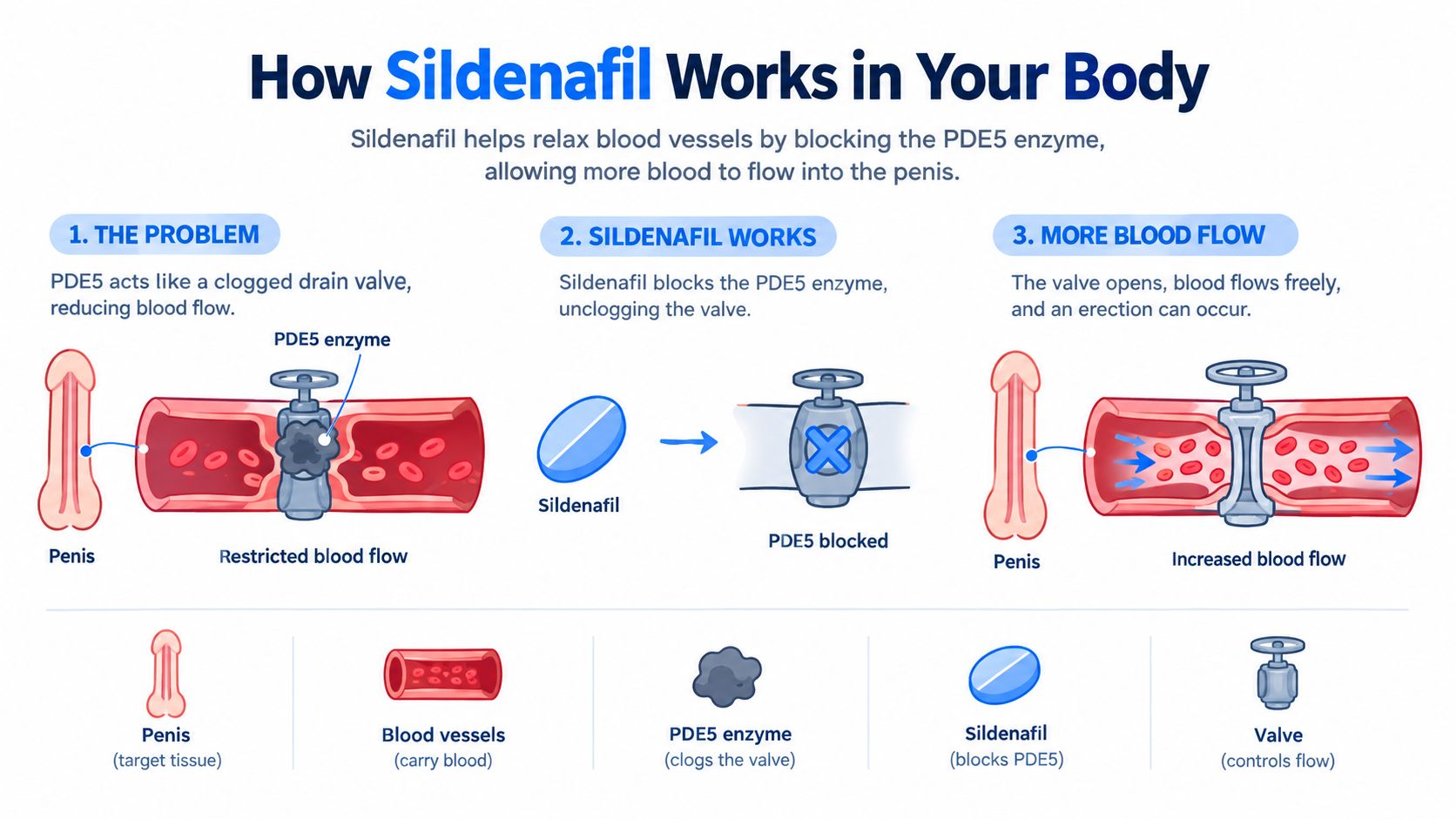
Think of blood flow like water moving through a pipe. Your body has signals that open the pipe wider when more flow is needed. Sildenafil helps that “open” signal last longer by blocking an enzyme called PDE5.
That extra relaxation can support blood flow in the penis during sexual stimulation. But blood vessels elsewhere can relax a bit too. That's why some people notice a pounding head, warmth in the face, or lightheadedness.
Why side effects show up outside sexual function
Many people get confused. They expect a medicine for erections to affect only erections. Bodies don't work that neatly.
Sildenafil can influence blood vessel tone and pressure, so effects may include:
Headache because widened blood vessels can trigger it
Flushing because skin blood vessels may relax
Stuffy nose because nasal passages contain blood vessels too
Upset stomach or indigestion because smooth muscle and blood flow changes can affect the digestive tract
Visual changes because sildenafil can also affect a related enzyme in the eye called PDE6
Why dose and timing still matter
The same medicine can feel different from person to person. A person taking other medicines, eating a heavy meal, drinking alcohol, or living with high blood pressure may interpret the same symptom very differently.
If sildenafil causes a symptom that seems stronger than “temporary annoyance,” don't assume it's harmless just because the medicine is commonly used.
The key idea is this. Sildenafil doesn't “cause random side effects.” Most generic Viagra side effects make sense once you understand that the medicine changes blood flow and can lightly affect nearby systems, including the nose, stomach, eyes, and blood pressure.
Common Side Effects and How Often They Occur
You take a dose, wait for the intended effect, and then notice a warm face, a mild headache, or a stuffy nose. That moment worries a lot of people because they are not sure whether they are feeling a normal medication effect or the start of a real problem.
The clearest trial data come from placebo-controlled studies in the FDA label. In those studies, 734 people took sildenafil and 725 took placebo, and the report lists the side effects that showed up most often and how often they happened in each group, according to the FDA Viagra labeling.
Common Sildenafil Side Effects vs Placebo in FDA Trials
Side Effect | Sildenafil % | Placebo % |
|---|---|---|
Headache | 16% | 4% |
Flushing | 10% | 1% |
Dyspepsia | 7% | 2% |
Nasal congestion | 4% | 2% |
Abnormal vision | 3% | 0% |
Diarrhea | 3% | 1% |
Dizziness | 2% | 1% |
Rash | 2% | 1% |
The same labeling reports that discontinuation due to adverse events was 2.5% with Viagra and 2.3% with placebo. In plain language, side effects were common enough to notice, but stopping because of them was uncommon in those trials.
What these common effects usually feel like
A simple way to read this table is to separate expected temporary effects from warning signs. Common effects are usually annoying, mild to moderate, and fade as the dose wears off. Red-flag symptoms are different. They are severe, unusual, or keep getting worse.
Headache is the most common complaint. It often feels like pressure or a dull throb. A useful comparison is a garden hose opened a little wider than usual. More flow can solve one problem while creating pressure in another area.
Flushing usually means warmth or redness in the face, neck, or chest. It can feel strange if you were expecting the medicine to act only in one part of the body.
Dyspepsia is the medical term for indigestion. People often describe it as upper stomach discomfort, mild burning, burping, or a too-full feeling.
Nasal congestion can feel like a stuffy nose without a cold. Abnormal vision in trial language usually means a temporary visual change, such as a bluish tinge, brightness changes, or blurred vision. That is different from sudden vision loss, which belongs in the serious-risk category.
How to judge what you are feeling
Severity matters more than the label "common."
If a symptom starts soon after dosing, stays mild, and eases over the next several hours, it usually fits the expected pattern. If it is strong enough to interrupt normal activity, lasts much longer than expected, or repeats every time you take sildenafil, it is worth a call to your prescriber or pharmacist.
The placebo comparison also helps. Some people reported headache, indigestion, and dizziness even without active medication, so the table is best used as a guide to patterns, not proof that every symptom is caused by sildenafil alone.
For readers comparing options, side-effect timing can differ with other ED medicines such as generic Cialis, so it helps to compare each drug on its own rather than assume they feel the same.
What you can usually do at home
If the symptom is mild and clearly temporary, home monitoring is often reasonable.
For headache: Rest, drink water, and avoid taking another dose to test whether it gets better.
For flushing or stuffiness: Give it time. These effects often settle as the medicine wears off.
For mild stomach upset: Keep meals simple around the dose and notice whether the same symptom happens again with future use.
A good rule is simple. Wait for mild, short-lived effects. Call your doctor for symptoms that are intense, persistent, or repeatedly bothersome. Seek urgent help for symptoms that feel abrupt, severe, or clearly outside the usual mild side-effect pattern.
Rare but Serious Risks You Should Not Ignore
A man takes sildenafil, notices a mild blue tint to his vision for a short time, and wonders whether to wait or panic. A different person develops chest pain or suddenly cannot hear well in one ear. Those situations do not belong in the same category, and that distinction matters.
Serious problems linked to sildenafil are uncommon, but they are the symptoms you should recognize quickly. Reports collected after wider real-world use added to what was seen in shorter trials, as described in the updated FDA sildenafil labeling. The practical question is not only, "what has been reported?" It is, "which symptoms can I safely watch, and which ones need immediate help?"
Which serious problems have been reported
The FDA label describes serious cardiovascular and cerebrovascular events reported in temporal association with sildenafil use, including myocardial infarction, sudden cardiac death, ventricular arrhythmia, cerebrovascular hemorrhage, transient ischemic attack, hypertension, pulmonary hemorrhage, and intracerebral hemorrhage.
It also describes reports of non-arteritic anterior ischemic optic neuropathy (NAION), which can lead to permanent vision loss.
Vision and hearing symptoms deserve special attention
This area causes the most confusion.
Sildenafil can briefly affect color perception because it does not act only on the target enzyme involved in erections. It can also affect a similar enzyme in the eye. The NCBI Bookshelf review of sildenafil notes these temporary color-vision changes, along with reports of NAION and sudden hearing loss, and notes greater concern in people with vascular risk factors such as hypertension, diabetes, high cholesterol, and cardiovascular disease.
A short-lived color shift is very different from sudden vision loss. One is an expected medication effect in some users. The other is a red-flag event.
The same idea applies to hearing. Brief awareness changes are not the main concern. Sudden hearing loss, especially in one ear or with ringing or dizziness, needs prompt medical attention.
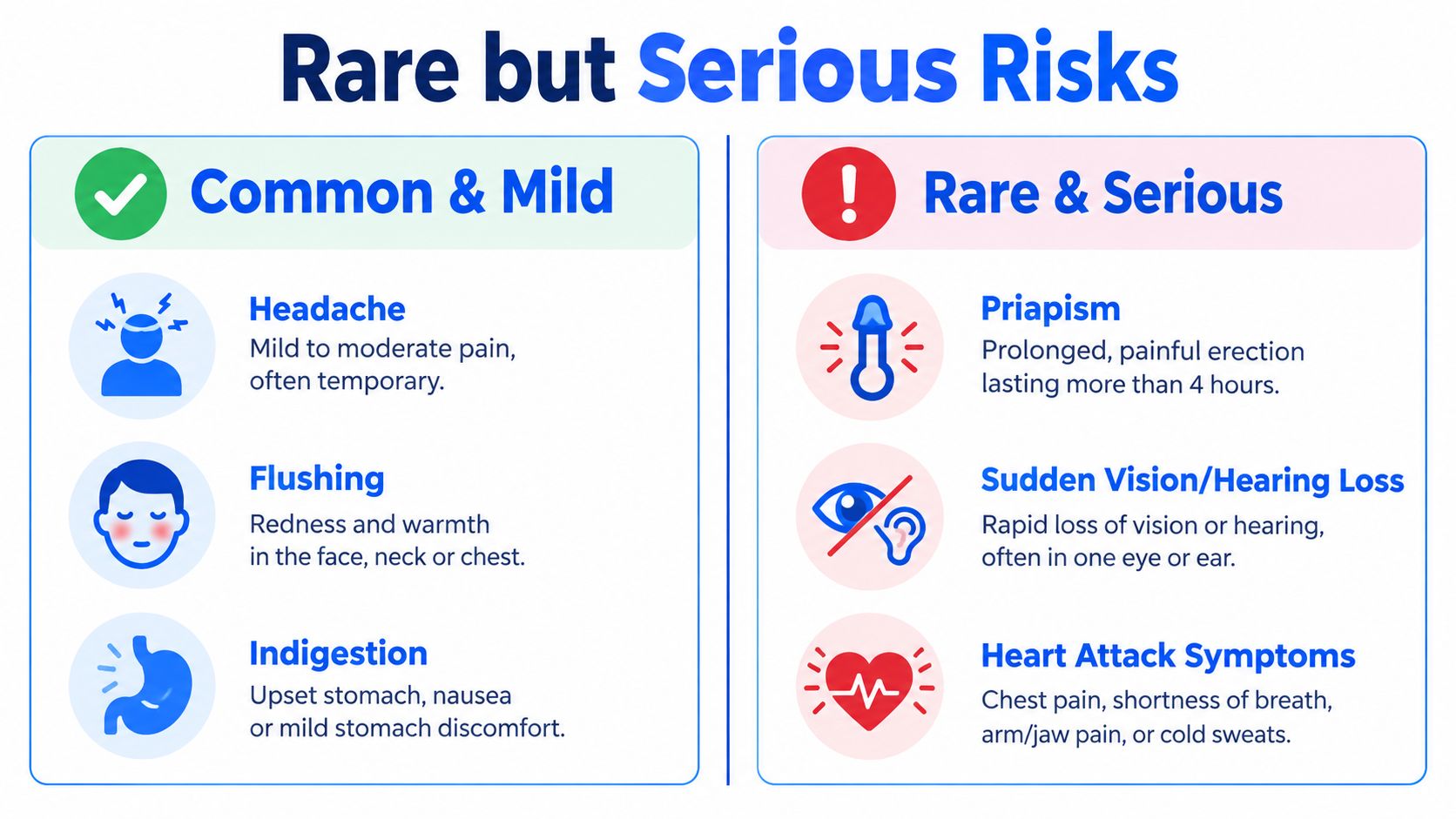
Here's a brief visual summary before the next decision point.
When the symptom is a red flag
Use a simple sorting rule. Mild, limited, temporary symptoms can often be watched. Abrupt, severe, or clearly worsening symptoms should be treated as urgent.
Get urgent medical help if you have:
Chest pain, fainting, or collapse: Especially during or soon after sexual activity or sildenafil use
Sudden vision loss or major reduction in vision: Especially in one eye
Sudden hearing loss or a major hearing change: Especially if it is one-sided or comes with ringing or dizziness
An erection lasting too long: A prolonged erection needs prompt treatment to help prevent permanent injury
If you are unsure, ask yourself one question: does this feel like a mild temporary medicine effect, or does it feel like something is suddenly not working right? That framework helps separate "wait and watch" symptoms from "get checked now" symptoms without minimizing either one.
Drug Interactions and Health Conditions That Raise Risk
A common real-world scenario goes like this. Someone takes sildenafil, feels flushed or a little headachy, and assumes any later symptom must be a normal side effect. The bigger safety question is often different: what else is in the body at the same time, and does that combination make a blood pressure drop more likely?
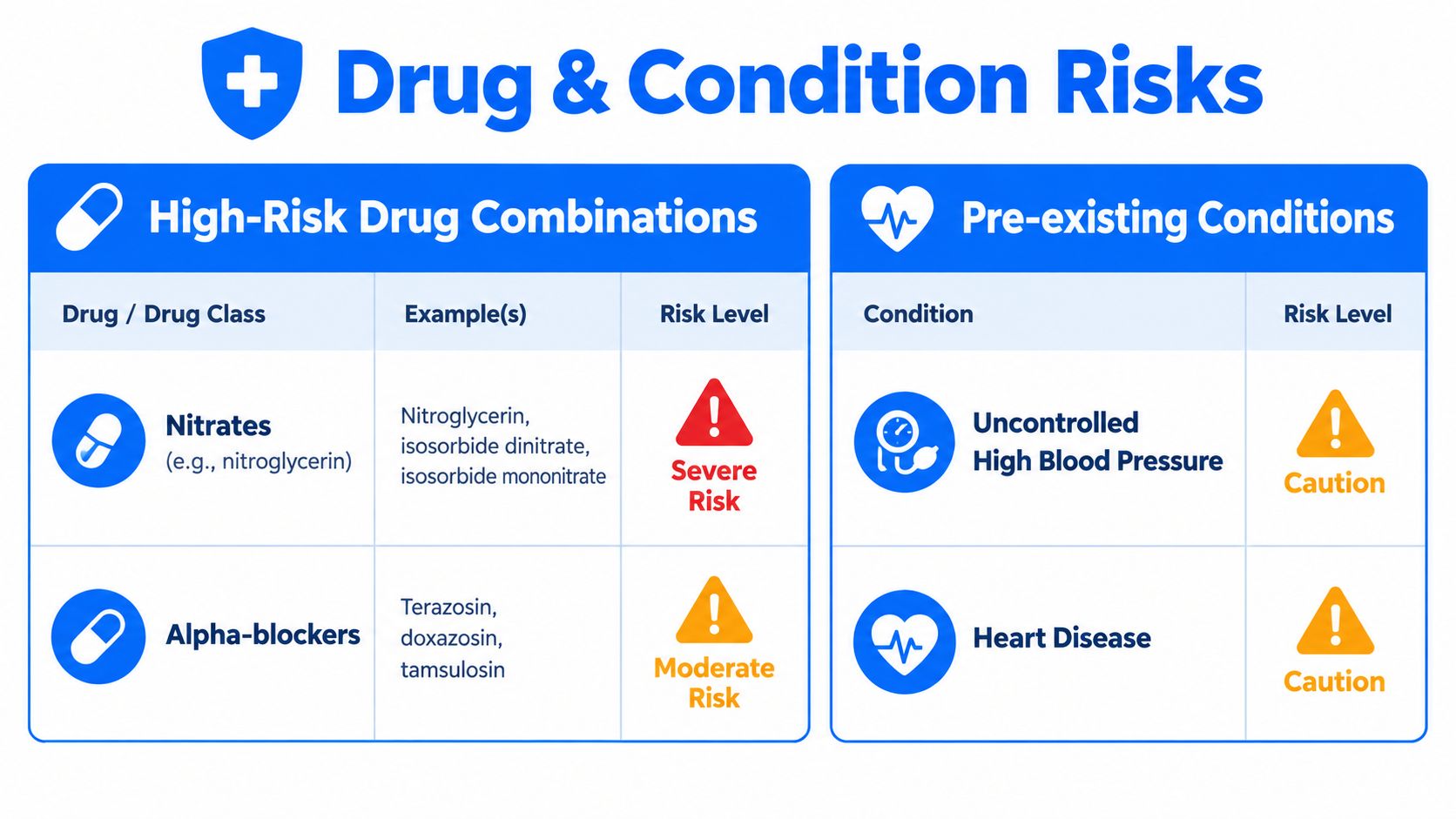
Sildenafil relaxes blood vessels. That helps blood flow where it is needed, but it also means other medicines that widen blood vessels or lower pressure can stack on top of it. The official concern highlighted in DailyMed sildenafil safety information is low blood pressure, especially when sildenafil is combined with nitrates.
The highest-risk combination
Nitrates deserve the clearest warning. They are used for chest pain and some heart conditions, and they already lower blood pressure by opening blood vessels. Sildenafil does the same through a different pathway. Together, the effect can become too strong.
That is why this is a do-not-mix combination, not a casual caution.
People may not recognize the word "nitrate" on their own. They may just think, "I have a heart tablet I use sometimes." That "sometimes" matters. As-needed medicines can create interaction risk just as easily as daily ones.
Other medicines and conditions that need caution
Other combinations can also raise risk, even if they are not as absolute as nitrates. Some blood pressure medicines, certain heart medicines, and some prostate medicines can add to dizziness, faintness, or a drop in pressure. Some medicines also change how sildenafil is broken down, which can make its effects stronger or last longer. A pharmacist reviewing a full medication list may check for interacting drugs such as ritonavir treatment that can affect sildenafil levels, not because it treats the same condition, but because metabolism interactions matter too.
Health conditions can complicate the picture in a similar way. The tablet has one effect. Your baseline health determines how much room your body has to tolerate that effect.
A few examples:
Diabetes: Nerve, blood vessel, or heart problems can make dizziness, visual symptoms, or sexual-function concerns harder to sort out.
High blood pressure: Treatment may already lower pressure, so adding sildenafil can increase lightheadedness in some people.
Heart or blood vessel disease: Chest symptoms, shortness of breath, or fainting deserve a lower threshold for medical advice.
Using several medicines at once: The more variables involved, the easier it is to miss an interaction hiding in an occasional tablet, supplement, or PRN medicine.
Symptoms that may suggest low blood pressure or an interaction
Interaction-related low blood pressure is often less dramatic than people expect. It can start as a "something feels off" pattern rather than a single severe symptom.
Symptom pattern | What it can mean |
|---|---|
Lightheadedness when standing | Blood pressure may be dropping too much |
New dizziness soon after taking sildenafil with another medicine | The combination may be contributing |
Feeling faint, weak, or unsteady | You should contact a clinician promptly |
Blurry vision along with wooziness | Can happen when pressure falls |
A simple decision rule helps here. Mild symptoms that are brief and fade may call for a medication review soon. Symptoms that are strong, worsening, or tied to fainting, chest pain, or near-collapse need urgent care.
Bring a complete medication list to any sildenafil discussion. Include daily prescriptions, as-needed chest pain tablets, supplements, and medicines you use only once in a while. Interaction problems often hide in the "I do not take it every day" group.
How to Use Generic Sildenafil More Safely and When to Seek Help
You take a tablet, then an hour later you notice a warm face, a mild headache, or a little dizziness when you stand up. That moment is where many people get stuck. Is this an expected side effect that will pass, or a warning sign that needs help now?
A safer plan starts before you swallow the first dose. Sildenafil works by relaxing blood vessels, so some temporary effects can come with the same process that helps blood flow. The goal is to lower avoidable risk, keep the first few doses predictable, and know which symptoms belong in the wait, call, or emergency category.
A simple safety routine
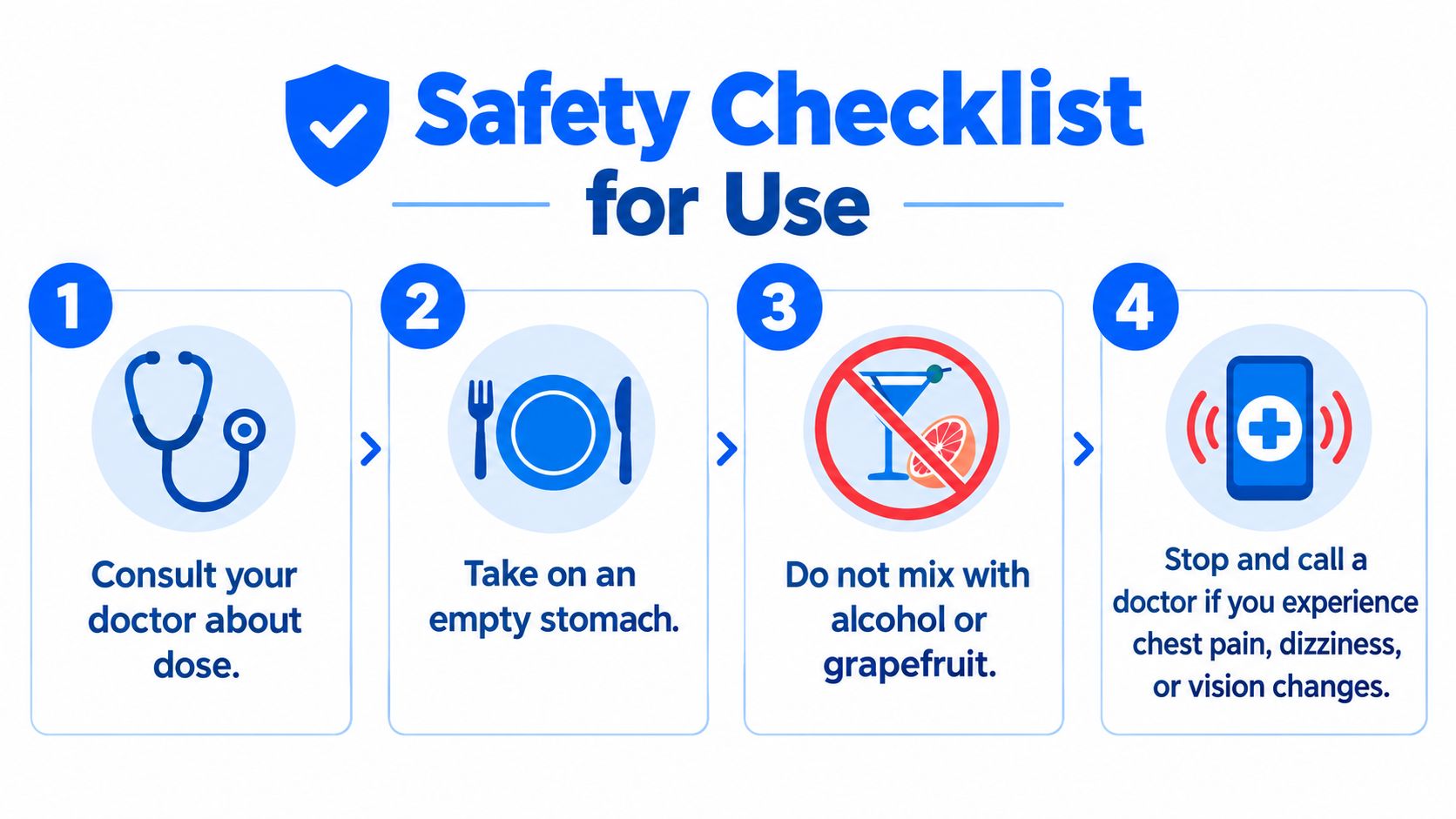
Start with the dose your clinician prescribed. Do not borrow someone else's routine or copy advice from a friend. Two people can take the same tablet and have different results because blood pressure, age, kidney or liver function, and other medicines all change the picture.
It also helps to make your first dose a "low-noise" test. Avoid heavy alcohol use that same day. Keep track of when you took the tablet, when symptoms started, and whether they faded on their own. That timing clue often helps separate a temporary medication effect from something less related.
Before using sildenafil, review your full medication list. Include medicines you take every day, pills you use only sometimes, and supplements. If you already take a prostate medicine such as tamsulosin tablets, ask your prescriber or pharmacist how to reduce the chance of extra dizziness or a blood pressure drop when the two are used together.
Buy from a legitimate pharmacy source, too. Clear labeling, the right strength, and pharmacist access reduce avoidable mistakes.
How to decide: wait, call, or get emergency help
A useful way to sort symptoms is to ask two questions. First, is it mild and fading, or sudden and intense? Second, does it stay in the "annoying but expected" group, or has it moved into chest symptoms, major vision or hearing changes, fainting, or a prolonged erection?
Wait and monitor when the effect is mild, familiar, and getting better. A slight headache, flushing, stuffy nose, mild indigestion, or a brief color tinge in vision can fit this group if it settles.
Call your doctor or pharmacist soon if a symptom keeps happening, lasts longer than you expected, feels stronger with each dose, or leaves you unsure whether another medicine is involved. Call as well if dizziness, lightheadedness, or blurred vision does not clear up as you rest, especially if you also use blood pressure or prostate medicines.
Seek emergency care now for chest pain, fainting, severe shortness of breath, sudden vision loss, sudden hearing loss, or an erection that lasts too long and does not go away.
One practical rule helps. Symptoms that slowly fade usually belong in a different category from symptoms that hit hard, escalate, or affect your ability to stand, see, hear, or think clearly.
A quick note on vision changes
This part worries many readers, and the distinction matters.
A temporary blue tint, brighter-looking light, or mild color shift can happen because sildenafil can affect a similar enzyme in the eye. That is different from sudden loss of vision, a dark curtain effect, or a major change in one eye. Mild visual effects that pass are usually monitored. Sudden or major vision loss needs immediate medical evaluation.
Key Takeaways for Safer Use of Generic Viagra
You take a dose, then notice a warm face, a mild headache, or a stuffy nose. That moment is where many people get stuck. Is this the normal, temporary kind of side effect, or a sign that something is moving into a riskier category?
A useful way to sort it out is to separate expected effects from red-flag symptoms. Sildenafil relaxes blood vessels. That same effect that helps blood flow for an erection can also cause short-term symptoms such as headache, flushing, indigestion, nasal congestion, dizziness, or brief visual changes. As noted earlier, the FDA label also reported that headache, flushing, and dyspepsia were among the more common side effects in controlled trials, while stopping treatment because of side effects was not common.
The practical question is not just, “Can sildenafil cause side effects?” It is, “What kind of side effect is this, and what should I do next?”
Use this simple decision guide:
Mild, familiar, and fading: wait and monitor
Repeated, bothersome, or hard to interpret: call your doctor or pharmacist
Sudden, intense, or affecting the chest, vision, hearing, or erection duration: seek urgent medical help
This framework works like a traffic light. Green means the symptom is mild and settling. Yellow means slow down and get advice before the next dose. Red means do not wait.
The highest-risk situations usually involve either a dangerous interaction or a symptom that points beyond an expected medication effect. Nitrates are the clearest example because the blood-pressure drop can be serious. Certain heart medicines, blood pressure medicines, alpha-blockers, and some health conditions can also change how safely sildenafil fits your situation.
A final point can lower a lot of anxiety. Temporary and improving symptoms usually belong in a different category from symptoms that arrive abruptly, grow stronger, or interfere with standing, seeing, hearing, or thinking clearly. That is the distinction to keep in mind.
If you're comparing sildenafil options or want a medication review before ordering, TheMedicineKart lists generic men's health treatments along with broader pharmacy categories, pharmacist order review, and customer support. That can be useful if your main concern isn't just cost, but also checking interaction risks and understanding what side effects to watch for.


Comments